Multiplier Systems and Symbol Stacking: Their Role in Determining Video Slot Payout Calculations

Contemporary video slot designs rely on layered mathematical frameworks where multiplier systems and symbol stacking directly shape the overall return-to-player percentages that operators publish for each title. These elements work together through code that calculates win probabilities across thousands of possible reel combinations, and developers adjust their values during the certification process to keep the published RTP within regulatory tolerances. Research from the University of Nevada's gaming mathematics program shows that even small changes in multiplier frequency or stack depth can shift the long-term return by several percentage points while preserving the appearance of frequent smaller payouts.
Core Components of Multiplier Integration
Multiplier mechanics appear in several distinct forms across modern titles, and each type interacts differently with the base game engine. Base multipliers attach to wild symbols and apply a fixed value such as 2x or 3x to any line win they complete, while progressive multipliers increase with each consecutive cascade or spin within a single paid round. Bonus round multipliers often start at higher values and climb through collection meters that players trigger by landing specific scatters. Data collected by the Nevada Gaming Control Board during machine submissions indicates that titles incorporating cascading multipliers maintain target RTP figures between 94 percent and 96 percent when the frequency of multiplier triggers stays below one in every 180 spins on average.
Designers calibrate these triggers against the total number of symbols on each reel strip so the mathematical model remains balanced. When a game introduces a 5x multiplier that activates once every 250 spins, the code compensates by reducing the frequency of mid-tier symbol combinations elsewhere on the reels. This adjustment prevents the overall return from drifting above the certified threshold during extended play sessions.
Symbol Stacking Mechanics and Reel Configuration
Stacked symbols occupy multiple consecutive positions on a single reel, and their placement alters both hit frequency and the size of individual payouts. Full stacks of high-value symbols create the possibility of multiple winning lines on the same spin when the grid expands or when adjacent reels also land matching stacks. Engineers position these stacks according to weighted reel strips that the certification labs verify through millions of simulated spins before approval. Reports from the Australian Communications and Media Authority highlight that games featuring three-symbol stacks on the first two reels combined with two-symbol stacks on the remaining reels typically achieve RTP values within 0.3 percentage points of the declared figure when tested across 10 million cycles.
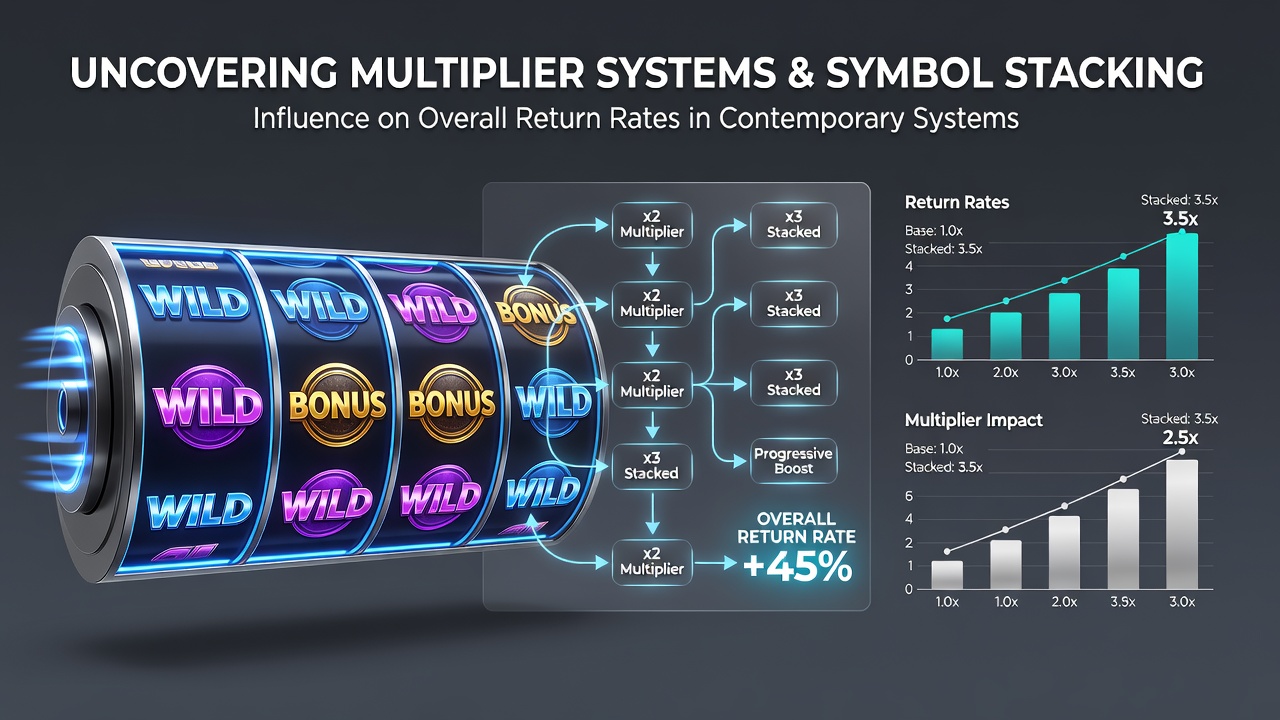
The interaction between stacking and multipliers becomes most visible during cascade sequences. When a stack clears and new symbols drop into place, any multiplier already active on the screen applies to the newly formed lines, which compounds the return calculation for that round. Observers note that this compounding effect requires careful tuning of the drop rate for replacement symbols so the average return per paid spin stays consistent with regulatory filings.
Impact on Overall Return Rates and Certification Data
Certification laboratories measure how multiplier frequency and stack depth influence the final RTP by running exhaustive simulations that record every possible outcome. When stacked symbols appear more often on lower-value positions, the game can deliver frequent small wins that keep players engaged while the rarer high-multiplier combinations account for the bulk of the theoretical return. Figures released by the Gaming Policy and Enforcement Branch of British Columbia demonstrate that titles with moderate stacking and occasional 4x multipliers posted average RTPs of 95.2 percent across a sample of 47 certified games submitted between January and June 2026.
Developers further refine these parameters by adjusting the number of reels that carry full stacks versus partial stacks. Games that place stacks on all five reels tend to require lower multiplier values to avoid exceeding the target RTP, whereas titles that limit stacks to two or three reels can support higher multipliers without shifting teh overall return outside acceptable bounds. This balancing act continues throughout the development cycle and receives final verification during the independent testing phase required by most jurisdictions.
Current Design Trends Observed in Mid-2026
By July 2026 several studios had begun experimenting with hybrid systems that combine symbol stacking with conditional multipliers tied to specific reel positions. These position-based multipliers activate only when a stack lands in designated columns, which adds another layer of probability that the mathematical model must account for during certification. Industry submissions reviewed by the New Jersey Division of Gaming Enforcement show that these hybrid mechanics appear in roughly 18 percent of new video slot titles approved during the first half of the year, and their RTP calculations remain within 0.5 percentage points of the published rates when tested under standard conditions.
Conclusion
Multiplier systems and symbol stacking continue to serve as primary tools for shaping return rates in contemporary video slot designs, and regulatory data from multiple jurisdictions confirms that precise calibration of these features allows developers to meet both entertainment goals and required payout percentages. The ongoing refinement of these mechanics reflects the need to balance player engagement with the mathematical constraints that govern long-term performance across certified games.