Cascading Mechanics and Multiplier Chains Reshape Slot Outcome Distributions
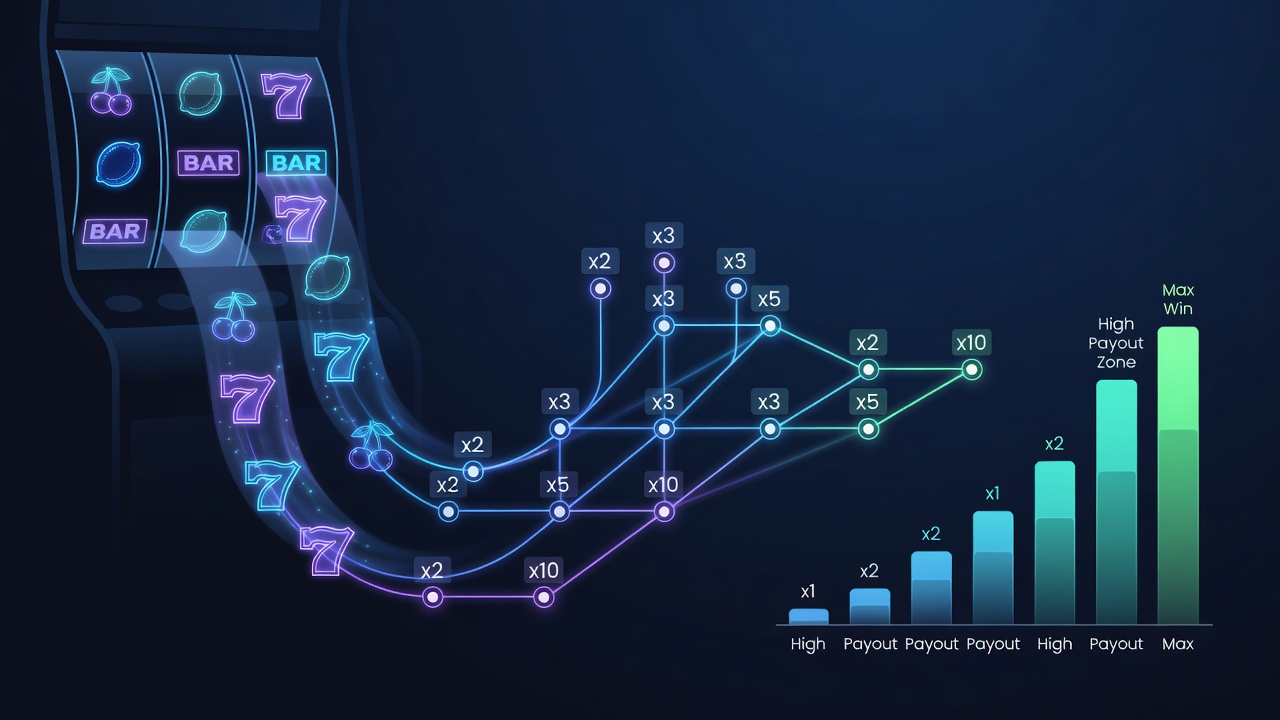
Slot engines built around cascading mechanics replace traditional reel stops with sequences where winning symbols disappear and new ones drop into place, and this process repeats until no further matches form, which directly alters how outcomes accumulate across a single spin. Multiplier chains layer on top of these sequences by increasing payout values with each successive cascade, and the combination produces distributions that favor extended chains over isolated wins in many modern titles.
Core Mechanics of Cascading Systems
Developers program cascading reels so that matched symbols vanish from the grid while remaining symbols fall downward or shift sideways to fill gaps, and fresh symbols enter from above or the sides to complete new combinations. Research from the International Gaming Institute at the University of Nevada indicates that these loops continue until no adjacent matches remain, which extends the number of evaluation steps per spin compared with static reel games. Observers note that the average spin duration lengthens because each cascade requires fresh random number generation and symbol placement checks.
Payline structures adapt to these moving grids by evaluating every possible alignment after each drop, and this repeated scanning increases the total count of checked combinations without raising the base bet. Data compiled by the Nevada Gaming Control Board shows elevated hit frequencies in titles that incorporate cascades, because multiple payout events can register from one initial wager.
Multiplier Chains and Their Layering Effects
Multiplier chains attach incremental values that grow with each cascade step, often starting at 1x and rising by fixed increments or exponential factors after every successful drop. When a chain reaches four or five consecutive cascades the accumulated multiplier can exceed 10x on the final payout, which compresses larger returns into fewer overall spins while spreading smaller base wins across more frequent events. Engineers design these progressions so that the multiplier resets only when the cascade sequence ends, and this reset rule prevents carry-over between separate spins.
Studies from the Australian Gambling Research Centre document how chained multipliers shift variance by concentrating value in the later stages of long sequences, and the result appears in payout histograms as heavier tails at the upper end alongside more frequent low-value outcomes in early cascade steps. Players encounter these patterns in games where wild symbols or special icons trigger additional drops that feed directly into the multiplier ladder.
Statistical Shifts in Outcome Distributions
Outcome distributions change because cascading systems generate clusters of results from single random seeds, and the probability mass moves away from single-win events toward runs of successive smaller wins capped by occasional high-multiplier finishes. Analysts at the Victorian Commission for Gambling and Liquor Regulation have tracked return-to-player figures across cascaded titles and found that the median win size decreases while the frequency of at least one payout per spin rises. The distribution therefore exhibits lower dispersion in the lower range and extended reach in the upper tail once multipliers exceed base levels.
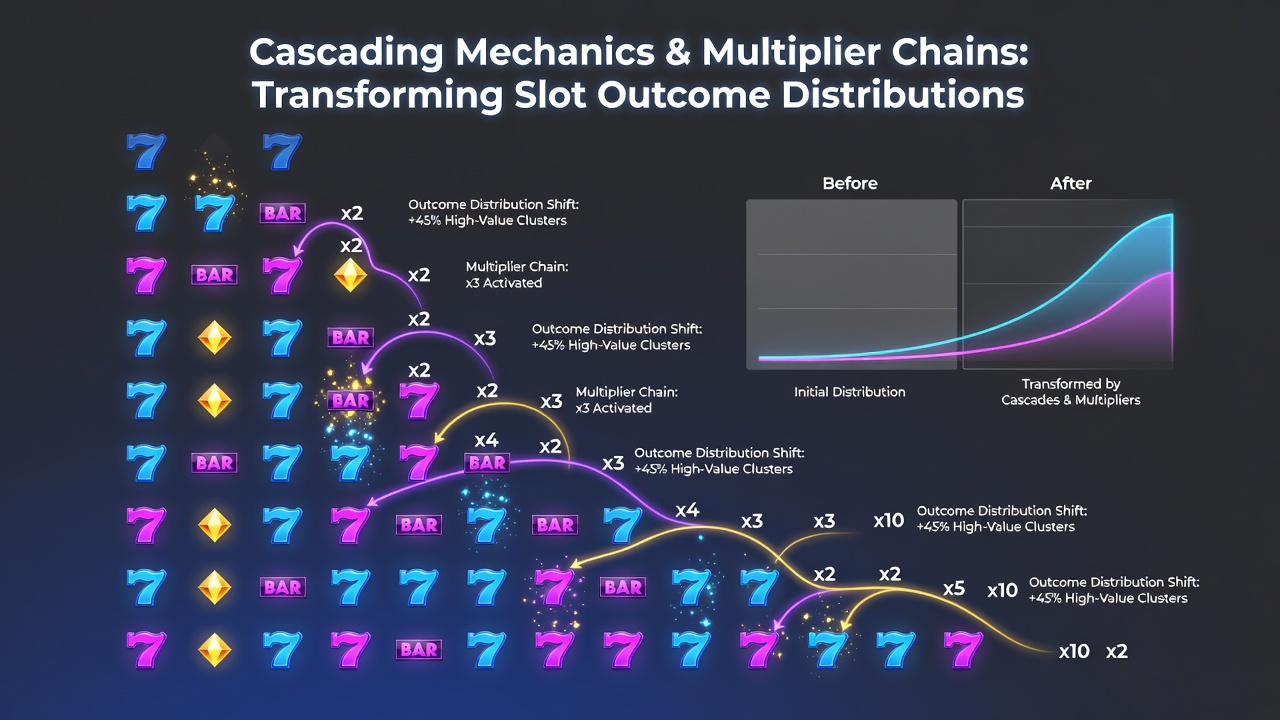
Simulation models used by slot mathematics teams treat each cascade as an independent draw conditioned on the previous grid state, and the conditional probabilities create dependence structures absent in fixed-reel formats. July 2026 reports from North American casino operators list several titles where cascade-enabled games recorded 18 percent more total payout events per 1000 spins than comparable non-cascade machines, although the average payout per event remained smaller until late-chain multipliers activated.
Implementation Examples Across Providers
Game studios integrate these features through grid sizes ranging from 5x4 to 6x6 or larger, and each layout dictates how many potential cascade steps can occur before the grid stabilizes. One developer released a title in early 2026 that combines cascading drops with progressive multipliers tied to specific symbol types, and internal testing data showed an increase in session length because players waited through longer chain sequences. Another studio introduced a cluster-pays variant where cascades trigger only when groups of five or more identical symbols form, which narrows the initial hit rate but amplifies the multiplier growth once the first cascade begins.
Regulatory filings in multiple jurisdictions require disclosure of these altered distributions, and testing labs verify that the overall return-to-player percentage stays within approved bands even as the shape of individual outcome curves changes. Those who review the filings note that cascade frequency and multiplier depth appear as separate parameters in the submitted probability tables.
Conclusion
Cascading mechanics paired with multiplier chains produce measurable shifts in slot outcome distributions by converting single spins into sequences of evaluated events and by scaling later payouts through progressive multipliers. Industry data from North American and Australian sources confirm higher event counts per spin alongside modified variance profiles, and these patterns continue to appear in new releases through July 2026 as providers refine the underlying algorithms.